Samsung Galaxy Z Fold8 Display: How Its OLED Panel Is Changing Foldable Smartphones
Samsung Galaxy Z Fold8 Display: How Its OLED Panel Is Changing Foldable Smartphones
Foldable smartphones have moved beyond being experimental devices. In 2026, Samsung is pushing the technology further with the Galaxy Z Fold8, a redesigned foldable smartphone that places its display technology at the center of the experience.
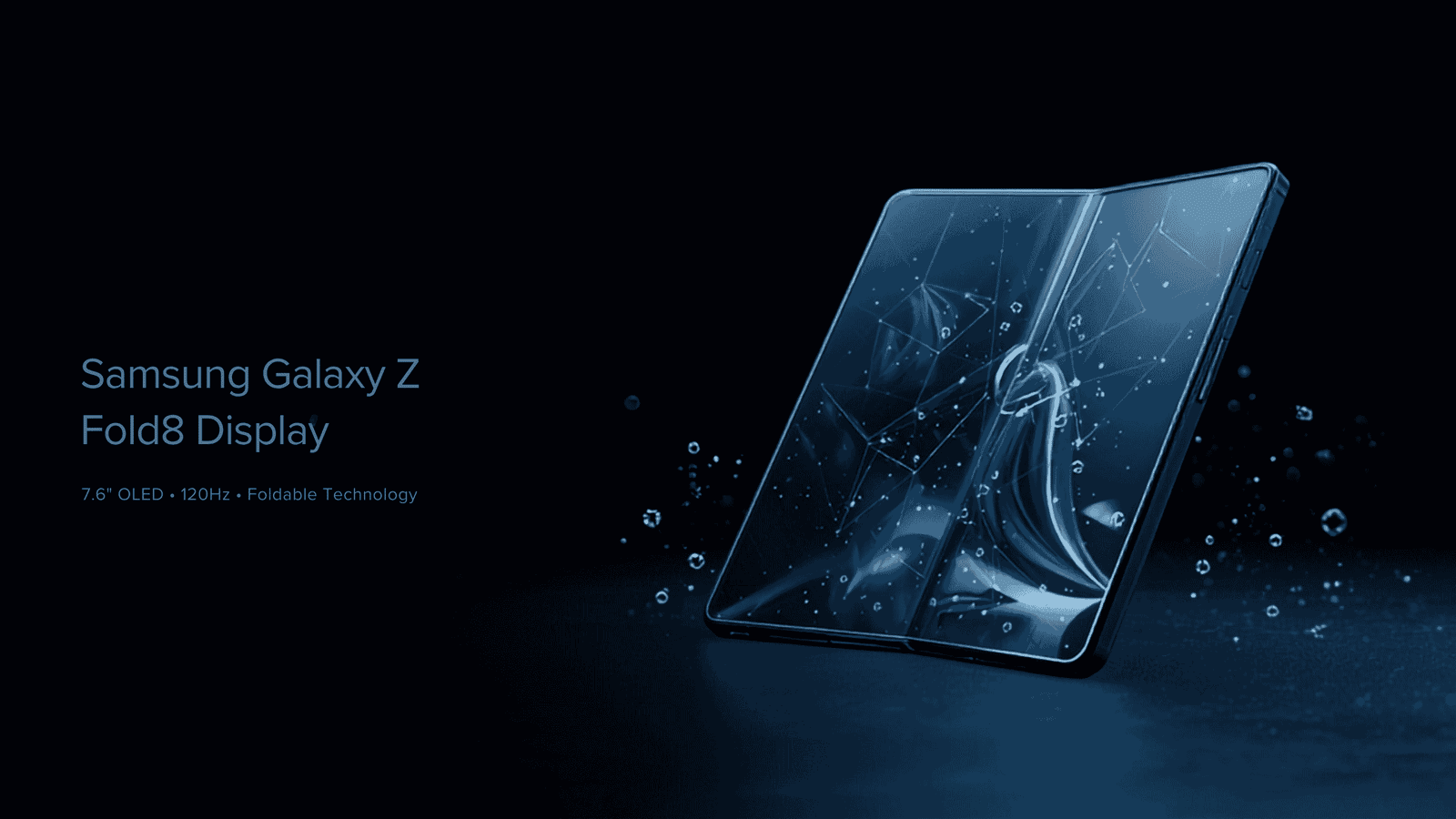
The Galaxy Z Fold8 features a 7.6-inch QXGA+ Dynamic AMOLED 2X main display with a 120Hz adaptive refresh rate, while the cover screen measures 5.5 inches and also uses Dynamic AMOLED 2X technology. Samsung says the main screen is designed around a new 4:3 aspect ratio for a more natural experience when watching content, gaming, reading and multitasking.
This makes the Galaxy Z Fold8 particularly interesting from a mobile display and panel technology perspective.
A New Generation of Foldable Displays
Traditional smartphones use a rigid display panel that remains flat during normal use. Foldable smartphones require something fundamentally different: a display capable of opening and closing repeatedly while continuing to produce a high-quality image.
Samsung’s Galaxy Z Fold8 uses a flexible Dynamic AMOLED 2X panel for its main display. The official specifications list a resolution of 1,848 × 2,448, 403 pixels per inch, and an adaptive refresh rate ranging from 1Hz to 120Hz.
The ability to dynamically adjust the refresh rate is important because the display does not need to operate at 120Hz all the time. Lower refresh rates can be used for static content, while higher refresh rates are available when scrolling, gaming or watching compatible content.
7.6-Inch Display in a Pocketable Device
One of the biggest advantages of the Galaxy Z Fold8 is the difference between its folded and unfolded experiences.
When closed, users have access to a 5.5-inch cover display. When opened, the device transforms into a much larger 7.6-inch screen. Samsung has redesigned the proportions around a 4:3 main display, while the cover screen uses a 10:16 ratio.
This allows the same device to function as:
- A conventional smartphone when folded
- A large-screen entertainment device when opened
- A multitasking workspace
- An e-reader
- A compact tablet-like device
Samsung specifically highlights the 4:3 main display for movies and games, while rotating the device to 3:4 makes the screen better suited to reading and web browsing.
Why the OLED Panel Matters
The display is arguably the most important component of a foldable smartphone because users interact with it continuously.
A high-quality OLED panel can provide:
- Deep blacks
- Strong contrast
- Vibrant colours
- Fast response
- Smooth animations
- High brightness
- Better viewing angles
The Galaxy Z Fold8’s display also supports Vision Booster, while Samsung lists up to a 120Hz adaptive refresh rate for both the main and cover displays.
A recent review from The Guardian described the 7.6-inch OLED screen as crisp, smooth and very bright, including strong visibility in direct sunlight.
Foldable Displays Are Different From Regular Smartphone Screens
The most interesting part of the Galaxy Z Fold8 isn’t simply that it has an OLED display. It is that the OLED panel has to operate while being part of a folding mechanism.
That creates a completely different set of engineering challenges.
A conventional smartphone screen is designed to remain flat. A foldable panel must withstand repeated movement while maintaining:
Image quality + touch response + structural flexibility + long-term reliability
This is one reason foldable display technology represents such an important development for the wider mobile-panel industry.
What This Means for Mobile Display Technology
The Galaxy Z Fold8 demonstrates how smartphone displays are evolving from simple flat panels into increasingly sophisticated components.
Today’s premium display technology has to deliver more than resolution.
It must also provide:
- Smooth refresh rates
- High brightness
- Accurate colours
- Efficient power consumption
- Responsive touch
- Structural durability
- Consistent performance
And as foldable smartphones become more common, these requirements will become increasingly important for the entire mobile display industry.
Sunlong Pakistan Connection
The evolution of phones such as the Galaxy Z Fold8 also highlights an important point for anyone dealing with mobile display replacement: panel quality matters.
When a smartphone screen is damaged, choosing a replacement panel based only on price can lead to compromises in brightness, colour reproduction, touch response and overall viewing quality.
For consumers and repair professionals in Pakistan, Sunlong Pakistan focuses on helping customers find high-quality mobile display panels through verified retailers. The idea is simple: as smartphone display technology becomes more advanced, users should have access to reliable panel options when their devices need repair or replacement.
What Comes Next?
The Galaxy Z Fold8 is more than another foldable phone. Its 7.6-inch Dynamic AMOLED 2X display, 120Hz adaptive refresh rate and redesigned aspect ratios show how manufacturers are trying to make flexible displays more useful in everyday life.
And because the device is now available globally, the technology is no longer just a future concept—it’s part of the current smartphone market. Samsung states that general availability began August 7, 2026.
Foldable OLED Technology & Screen Durability
How Does the Galaxy Z Fold8’s Foldable OLED Work?
The biggest difference between the Galaxy Z Fold8 and a conventional smartphone is that its main display has to bend repeatedly while continuing to function as a high-resolution touchscreen.
Samsung uses a 7.6-inch QXGA+ Dynamic AMOLED 2X main panel with a resolution of 1,848 × 2,448 pixels, 403 ppi and an adaptive refresh rate of 1–120Hz. The 5.5-inch cover display also uses Dynamic AMOLED 2X technology and supports 1–120Hz.
This combination gives the Fold8 two different display experiences: a conventional smartphone screen when closed and a much larger tablet-like OLED screen when unfolded.
Why 120Hz Matters on a Foldable Phone
The Galaxy Z Fold8’s adaptive 120Hz refresh rate is particularly useful when interacting with its large inner screen.
A higher refresh rate can make:
- Scrolling feel smoother
- Animations appear more fluid
- Touch interactions feel more responsive
- Gaming movement look smoother
- App transitions feel more natural
At the same time, the panel can reduce its refresh rate when high refresh rates aren’t necessary, with Samsung specifying an adaptive range of 1–120Hz. This helps balance smoothness with power efficiency.
Foldable OLED vs Traditional AMOLED
A regular smartphone AMOLED panel is designed to remain flat. A foldable OLED panel has to perform under repeated mechanical movement.
That creates additional engineering challenges.
| Feature | Traditional AMOLED | Foldable OLED |
|---|---|---|
| Physical structure | Rigid/flat | Flexible |
| Folding | No | Yes |
| Mechanical stress | Lower | Higher |
| Hinge integration | Not required | Essential |
| Protection structure | Conventional | Specialized |
| Manufacturing complexity | Lower | Higher |
| Replacement complexity | Generally simpler | Significantly more complex |
The important point is that a foldable display isn’t simply a normal OLED screen with a hinge added to it. The display, protective layers and hinge system have to work together.
How Samsung Is Improving Fold8 Durability
Samsung says the Galaxy Z Fold8 uses several structural technologies designed to improve durability.
The device has an Armor Aluminum frame, Gorilla Glass Ceramic 3 on the front, Gorilla Glass Victus 2 on the back, and two titanium layers underneath the display’s shock-absorbing structure. Samsung also uses its Armor FlexHinge for the folding mechanism.
The phone carries an IP48 rating, providing protection against water exposure and larger solid particles under the specified test conditions.
These improvements matter because foldable phones have traditionally faced a unique durability challenge: the screen must remain flexible while still providing the visual quality users expect from a premium OLED panel.
The Crease Is Still an Important Part of Foldable Displays
One of the most recognizable characteristics of a foldable phone is the crease where the display bends.
The crease isn’t simply a cosmetic detail. It is a visible reminder that the panel has a fundamentally different construction from a conventional flat smartphone screen.
For users, the important factors are:
- How visible the crease is
- How the display behaves while opening and closing
- Whether touch response remains consistent
- Whether brightness remains uniform
- How the panel performs over extended use
Recent reviews of the Fold8 have praised its large OLED screen for being crisp, smooth and bright, while also noting that the unusual 4:3 format makes it particularly suited to reading and tablet-style use.
Why Foldable Screen Replacement Is Different
This is where the topic becomes especially relevant to the mobile display industry.
Replacing a conventional flat smartphone screen is already a precision job. A foldable phone adds another level of complexity because the replacement display has to work correctly with:
- Flexible OLED construction
- Touch digitizer
- Protective layers
- Folding mechanism
- Hinge alignment
- Display connectors
- Device calibration
A poor-quality or incorrectly installed panel can affect not only image quality but also the way the device folds and responds to touch.
That’s why foldable display replacement should be approached differently from a conventional smartphone screen repair.
What This Means for Sunlong Pakistan
The Galaxy Z Fold8 demonstrates how quickly mobile display technology is evolving.
As phones move from traditional flat AMOLED panels toward flexible OLED and foldable displays, the importance of panel quality becomes even greater.
For customers who need a replacement screen, specifications such as brightness, colour reproduction, touch responsiveness and durability should be considered alongside price.
This connects directly with Sunlong Pakistan’s role in the mobile display market. Through its verified retailer network, Sunlong Pakistan helps customers find reliable sources for high-quality mobile display panels. As display technology becomes more advanced, having access to trusted retailers becomes increasingly important for both consumers and repair professionals.
The Bigger Picture
The Galaxy Z Fold8 isn’t just another Samsung smartphone. It represents a broader shift in how smartphone displays are being designed.
The industry is moving toward displays that are:
larger + thinner + brighter + smoother + more flexible
And foldable OLED technology is one of the clearest examples of that evolution.
With Samsung now selling the Galaxy Z Fold8 globally, foldable displays are becoming increasingly mainstream rather than remaining a niche experiment.
Galaxy Z Fold8 Display vs Traditional AMOLED & Replacement Guide
Galaxy Z Fold8 Display vs a Normal AMOLED Screen
The Samsung Galaxy Z Fold8 takes OLED display technology into a different category. A conventional AMOLED smartphone uses a rigid, flat panel, while the Fold8’s main screen has to operate while folding and unfolding.
Samsung’s current specifications list the Fold8’s main display at 7.6 inches, with a 1–120Hz adaptive refresh rate and brightness of up to 3,000 nits. The cover display is 5.5 inches, giving users a conventional phone experience when the device is closed.
This makes the Fold8’s display particularly useful for people who want a large screen without carrying a separate tablet.
What Makes the Fold8 Screen Different?
A normal AMOLED panel mainly needs to maintain image quality, touch responsiveness and structural stability.
A foldable OLED panel has to deal with additional requirements:
- Repeated folding and unfolding
- Mechanical stress
- Flexible display construction
- Hinge movement
- Protective-layer durability
- Consistent touch performance
- Uniform brightness across the folding area
Samsung says the Fold8 uses an Armor FlexHinge, Armor Aluminum and two titanium layers underneath the display’s shock-absorbing structure. The device also uses Corning Gorilla Glass Ceramic 3 on the front and Gorilla Glass Victus 2 on the rear.
These materials are designed to make the overall device more resistant to everyday wear and impacts.
Is the Fold8 Display Actually Better?
For certain types of usage, yes.
The large inner screen is particularly useful for:
🎬 Watching Videos
The larger 7.6-inch OLED panel provides considerably more screen area than a conventional smartphone.
📖 Reading
The unusual aspect ratio gives the Fold8 a more tablet-like reading experience.
💻 Multitasking
The large display allows multiple applications to be used side-by-side, making the device useful for productivity as well as entertainment.
🎮 Gaming
The high refresh rate and large OLED panel provide smoother motion and a more immersive gaming experience.
Recent reviews have highlighted the Fold8’s large OLED screen as one of its strongest features, while also noting that the unusual form factor can make conventional phone tasks such as one-handed typing less comfortable.
But Foldable Displays Still Have Challenges
Despite the improvements, foldable displays are not identical to conventional flat smartphone screens.
The biggest challenge is the flexible construction.
A flat smartphone display doesn’t normally experience repeated bending. A foldable display does.
That means users should take additional care with the inner screen.
Avoid:
- Pressing hard on the folding area
- Using sharp objects on the inner display
- Applying excessive pressure while cleaning
- Removing or damaging the factory-applied protective layer
- Allowing dust or debris to accumulate around the hinge
The Fold8 is considerably more durable than earlier generations, but IP48 protection and reinforced construction do not make the flexible OLED panel indestructible. Samsung specifically positions the device’s durability improvements as protection for everyday use rather than immunity from physical damage.
What Happens If the Fold8 Display Gets Damaged?
This is where foldable phones become particularly interesting from a mobile display replacement perspective.
With a traditional smartphone, replacing a damaged screen is already a precision repair. With a foldable phone, the repair can be considerably more complicated because the display is integrated into a folding structure.
A replacement process may involve considerations around:
- Flexible OLED panel
- Touch digitizer
- Protective layers
- Display connectors
- Hinge alignment
- Frame condition
- Calibration
- Folding mechanism
Therefore, a damaged foldable display shouldn’t be treated exactly like a conventional flat-screen replacement.
Why Panel Quality Matters
If a replacement panel is required, choosing purely on price isn’t the best approach.
A quality replacement panel should aim to provide:
Accurate colours
Consistent brightness
Responsive touch
Smooth refresh performance
Reliable construction
Poor-quality panels can potentially create a noticeable difference in the overall viewing experience.
For an advanced device such as the Galaxy Z Fold8, the difference between a quality panel and a low-quality replacement can be even more noticeable because the phone’s entire experience is built around its sophisticated flexible display.
Sunlong Pakistan: Where Does It Fit?
This is where the evolution of foldable phones connects directly with Sunlong Pakistan.
As smartphone manufacturers move from traditional flat displays toward advanced OLED and flexible display technologies, panel quality is becoming increasingly important.
For customers whose smartphones require display replacement, Sunlong Pakistan focuses on helping them find high-quality mobile display panels through verified retailers.
The idea isn’t simply to find the cheapest available screen.
The goal is to help customers locate a suitable retailer and choose a display solution that can deliver a reliable combination of:
- Display quality
- Colour performance
- Touch response
- Brightness
- Durability
This becomes increasingly important as smartphones become more technologically advanced.
The Future of Smartphone Displays
The Galaxy Z Fold8 represents a broader change happening across the smartphone industry.
The future isn’t simply about making displays bigger.
It’s about making them:
Bigger + thinner + brighter + smoother + flexible
Samsung’s latest Fold8 demonstrates this direction particularly well: a 7.6-inch foldable OLED display, up to 120Hz adaptive refresh, up to 3,000 nits brightness, and a redesigned structure intended to make the folding experience more practical.
And because the Galaxy Z Fold8 went on sale globally on August 7, 2026, this technology is now part of the mainstream smartphone market rather than merely a concept for the future.
Final Takeaway
The Galaxy Z Fold8 shows that the smartphone display is becoming much more than a simple screen.
Its flexible OLED panel has to combine image quality, touch responsiveness, brightness and mechanical flexibility in one component.
For users, this means taking better care of the display. For repair professionals and mobile-parts suppliers, it means that panel quality and technical compatibility are becoming increasingly important.
And for the wider mobile display industry, foldable phones such as the Galaxy Z Fold8 demonstrate where smartphone screen technology could be heading next.
Final Verdict: Is the Galaxy Z Fold8 Display Worth the Hype?
The Samsung Galaxy Z Fold8 shows how far foldable display technology has progressed. Samsung officially lists a 7.6-inch QXGA+ Dynamic AMOLED 2X main display, 1,848 × 2,448 resolution, 403 ppi, and an adaptive 1–120Hz refresh rate. The cover display is a 5.5-inch WUXGA+ Dynamic AMOLED 2X panel with a 1–120Hz adaptive refresh rate.
What makes the Fold8 particularly interesting isn’t simply its screen size. It’s the combination of a large OLED panel with a folding form factor. When opened, the 4:3 display provides a more tablet-like workspace for reading, browsing, video and multitasking.
A review published today also praised the Fold8’s inner OLED display for being crisp, smooth and very bright, while noting that the softer flexible screen requires more care than a conventional smartphone display.
However, the Fold8’s unusual shape isn’t perfect for everyone. Its wider, shorter closed design can make one-handed use and typing less convenient. The device is also expensive, and its flexible inner display remains more delicate and costly to repair than a conventional flat smartphone screen.
Galaxy Z Fold8 Display Specifications
| Feature | Galaxy Z Fold8 |
|---|---|
| Main Display | 7.6-inch QXGA+ Dynamic AMOLED 2X |
| Resolution | 1,848 × 2,448 |
| Pixel Density | 403 ppi |
| Refresh Rate | 1–120Hz Adaptive |
| Main Display Technology | Dynamic AMOLED 2X |
| Cover Display | 5.5-inch WUXGA+ Dynamic AMOLED 2X |
| Cover Resolution | 1,248 × 1,972 |
| Cover Pixel Density | 428 ppi |
| Cover Refresh Rate | 1–120Hz Adaptive |
| Main Aspect Ratio | Approximately 4:3 |
| Weight | 201g |
| Water Resistance | IP48 |
These specifications come from Samsung’s official Galaxy Z Fold8 announcement.
Why Foldable Display Quality Matters
The Galaxy Z Fold8 demonstrates an important trend in the smartphone industry: the display is becoming increasingly sophisticated.
Modern premium panels have to combine:
- High resolution
- Accurate colours
- High brightness
- Smooth refresh rates
- Responsive touch
- Power efficiency
- Structural durability
A foldable display adds another requirement: flexibility.
This makes the panel considerably more complex than a conventional flat smartphone display.
What If the Fold8 Screen Gets Damaged?
A damaged foldable display shouldn’t be treated exactly like a normal smartphone screen.
Because the inner panel is flexible and integrated with the folding structure, replacement requires careful consideration of the display assembly, protective layers, connectors and hinge mechanism.
A recent review reported that an inside-screen repair can cost around £600, highlighting how expensive foldable display repairs can be.
This makes choosing a reliable replacement solution particularly important.
How Sunlong Pakistan Fits Into the Foldable Display Trend
The Galaxy Z Fold8 is a good example of why mobile display quality matters more than ever.
As smartphone manufacturers move from traditional flat panels toward advanced OLED and flexible displays, customers increasingly need reliable information about display quality when a screen requires replacement.
Sunlong Pakistan can naturally become part of this conversation by helping customers find high-quality mobile display panels through verified retailers.
Instead of simply choosing a replacement based on the cheapest price, customers can use a trusted retailer network to find display solutions appropriate for their device.
This approach is particularly relevant as mobile displays become more advanced and replacement decisions become more technically demanding.
Frequently Asked Questions
Is the Samsung Galaxy Z Fold8 display OLED?
Yes. Samsung officially lists the main 7.6-inch panel and 5.5-inch cover panel as Dynamic AMOLED 2X displays.
What is the Galaxy Z Fold8 main display size?
The main unfolded display measures 7.6 inches diagonally and has a resolution of 1,848 × 2,448 pixels.
Does the Galaxy Z Fold8 support 120Hz?
Yes. Both the main and cover displays support an adaptive refresh rate from 1Hz to 120Hz.
Is the Galaxy Z Fold8 display durable?
Samsung has introduced structural improvements to the Fold8, but its flexible inner screen remains more delicate than a conventional flat smartphone display. Independent testing and reviews also emphasize that the flexible material requires more care.
Is Galaxy Z Fold8 screen replacement expensive?
Foldable display repairs can be significantly more expensive than conventional smartphone screen repairs. A current review reported approximately £600 for an inner-screen repair. Actual costs vary by market and repair provider.
Why should I choose a quality replacement panel?
A suitable replacement panel can help preserve important aspects of the display experience, including brightness, colour reproduction, touch response and overall reliability.
Powered by Sunlong Pakistan
This article is proudly published by Sunlong Pakistan, helping customers make informed decisions about mobile display quality and connect with trusted retailers across Pakistan.
For more expert guides, repair tips, and smartphone display insights, explore our FAQs, visit our Website, use our Store Locator, learn more on our Become a Seller page, and stay connected with us on Facebook, Instagram, TikTok and YouTube for the latest updates and educational content.