Samsung Wide View OLED: New Foldable Display Technology Explained
Samsung’s New Wide View OLED Display Could Change the Future of Foldable Phones
Foldable smartphones have come a long way in recent years. Manufacturers have improved hinges, reduced device thickness, increased display brightness and made the famous centre crease less noticeable. But even as foldable phones become more advanced, display manufacturers still face a difficult challenge: how can a flexible OLED screen maintain consistent image quality across the entire panel, especially around the folding area?
Samsung Display has now introduced a new technology aimed directly at this problem.
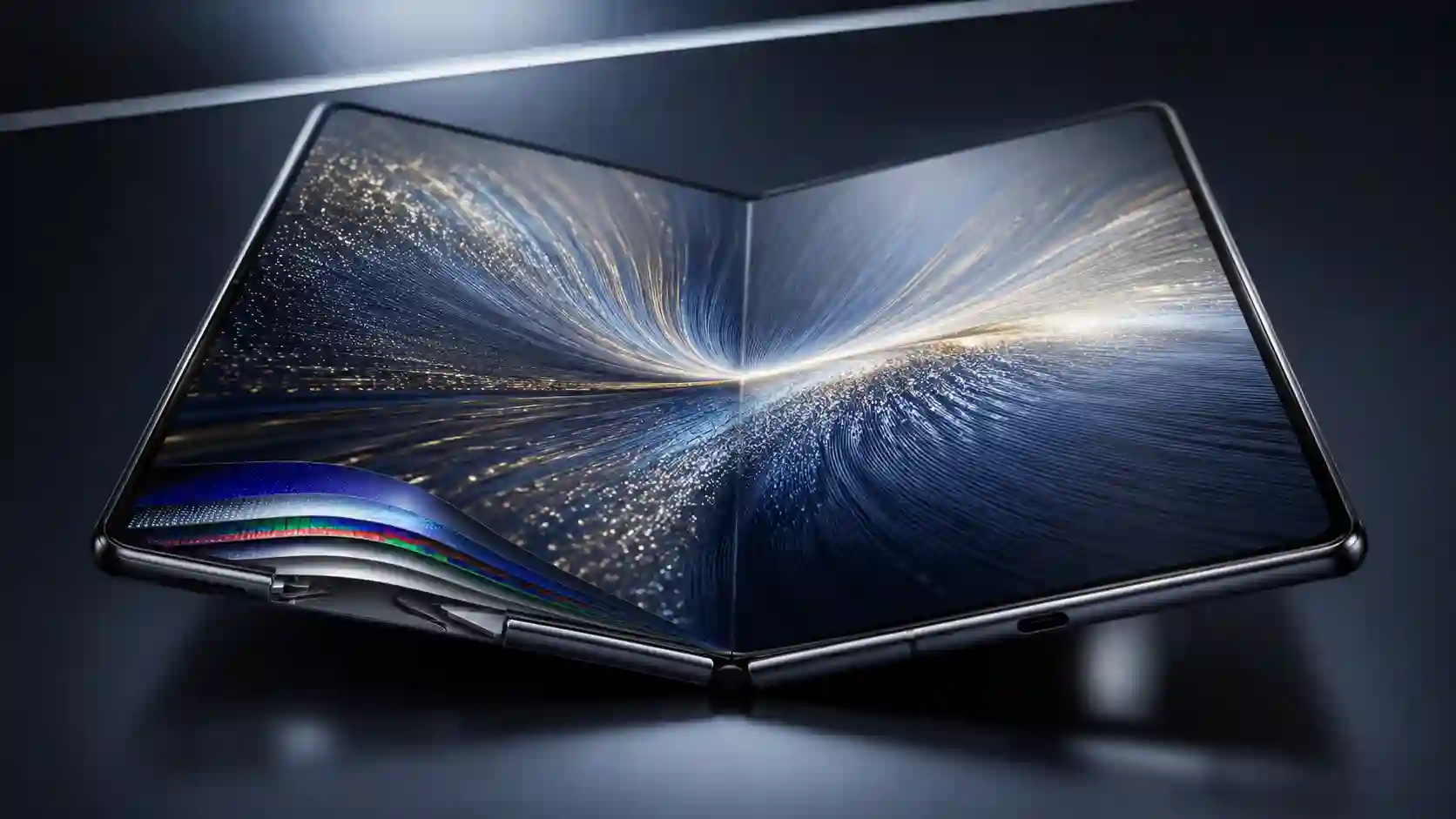
At IMID 2026, Samsung Display unveiled a new 7.6-inch Wide View Display designed to improve brightness and image uniformity around the curved folding area of foldable OLED panels. The technology could eventually influence the next generation of foldable smartphones, as well as other flexible display products.
The Problem With Foldable OLED Displays
A foldable OLED display has to perform a job that conventional smartphone screens don’t have to handle.
A normal OLED panel stays flat.
A foldable OLED panel has to repeatedly bend.
That creates additional engineering challenges around the folding area.
The display has to remain flexible while maintaining brightness, colour accuracy, touch performance and overall image quality.
One of the problems Samsung Display is targeting with its new Wide View technology is brightness degradation around the curved folding section.
According to Samsung Display, conventional foldable OLED panels can experience a significant reduction in brightness around the fold area when viewed from certain angles. The company says brightness in the curved area can fall to approximately 40% of the brightness seen on the front-facing portion of the display.
For users, this can contribute to the visual difference between the flat part of the screen and the folding area.
Samsung’s New Approach
Samsung Display says it has redesigned the material and structure of the organic light-emitting layer to improve brightness uniformity across the curved portion of the display.
Instead of treating the fold area as simply a mechanical challenge, the new technology addresses the OLED’s light-emitting characteristics as well.
This is significant because foldable display development is becoming increasingly sophisticated.
The industry is no longer focused only on making a panel flexible.
Manufacturers are now working on how light behaves across a flexible surface when that surface changes shape.
The new Wide View Display is designed to provide more consistent image quality regardless of viewing angle, particularly around curved and folded sections.
Why Viewing Angle Matters
Viewing angle becomes especially important on a foldable smartphone.
When a conventional flat phone is held directly in front of the user, most of the display remains at a similar viewing angle.
A foldable device is different.
Its screen can contain a curved or folded section, meaning different portions of the OLED can be viewed at different angles.
This can affect how much light reaches the viewer.
If one section of the display appears significantly darker than another, the difference can become visible while watching videos, browsing websites or viewing images.
Samsung’s Wide View technology is intended to reduce this variation.
The objective is a more uniform display where brightness remains consistent across both the flat and curved portions of the panel.
Why This Could Matter for Future Galaxy Fold Devices
Samsung Display has not said that this exact 7.6-inch Wide View panel will be used in a specific future Galaxy smartphone.
However, the technology provides an indication of where foldable OLED development is heading.
Samsung’s current foldable displays already use advanced structures such as Flex Titanium, which combines a titanium-alloy film and titanium plate to balance flexibility, strength and thinness.
The next step is improving the optical performance of the flexible OLED itself.
This could eventually lead to foldable phones where the folding area becomes less noticeable not only because the physical crease is reduced, but also because brightness and image quality remain more consistent across the fold.
The Crease Is More Than a Physical Line
When people talk about foldable displays, the first thing they usually mention is the crease.
But the crease is not simply a visible line.
It is the result of a complicated combination of mechanical and optical effects.
The display bends.
The OLED layers experience different stresses.
Light can behave differently across the curved surface.
Brightness can change depending on viewing angle.
Touch and visual perception can also be affected.
This means solving the foldable-display problem requires more than simply creating a stronger hinge.
The panel itself has to be engineered for the folding environment.
Samsung’s new Wide View Display demonstrates this shift toward a more comprehensive approach to foldable OLED technology.
From Flexible Screens to Advanced Flexible Panels
The evolution of foldable OLED technology can be viewed in several stages.
The first challenge was simply making OLED flexible enough to fold.
Then manufacturers focused on making the devices durable enough for everyday use.
After that came improvements in the hinge and display support structure.
Now manufacturers are focusing more heavily on visual consistency across the folding area.
This is an important development because consumers increasingly expect foldable phones to provide the same display quality as premium conventional smartphones.
A foldable screen shouldn’t feel like a compromise simply because it bends.
It needs to deliver high brightness, strong colours, smooth refresh rates and consistent image quality throughout the panel.
Samsung Display Is Looking Beyond Smartphones
The Wide View technology isn’t necessarily limited to foldable smartphones.
Samsung Display says the technology can also be applied to other next-generation form factors, including slidable and rollable displays.
That makes the development particularly interesting.
Foldable phones are only one part of the flexible-display market.
Future devices could include:
- Rollable smartphones
- Slidable tablets
- Flexible laptops
- Automotive displays
- Curved information screens
- Expandable wearable displays
All of these products could face similar problems involving brightness consistency across curved surfaces.
A technology developed for one display form factor can therefore eventually influence several areas of the electronics industry.
The Mobile Panel Market Is Changing
For the mobile-panel industry, developments like Wide View OLED are important because they show how quickly display technology is becoming specialized.
In the past, customers mainly compared panels based on specifications such as:
Resolution
Brightness
Refresh rate
Colour
Today, flexible displays require additional considerations.
Manufacturers and panel suppliers also need to consider:
Flexibility
Folding durability
Viewing-angle performance
Crease behaviour
Brightness uniformity
Structural support
Power efficiency
This creates a growing market for specialized mobile panels.
For customers and repair businesses in Pakistan, understanding these differences can become increasingly important as more advanced OLED and foldable smartphones enter the market.
Sunlong Pakistan can naturally fit into this evolving mobile-panel ecosystem by helping customers and retailers stay connected with modern panel technologies as the market moves from traditional rigid screens toward flexible OLED solutions.
What the New Technology Could Mean for Consumers
For the average smartphone user, the technical details may sound complicated.
The practical goal is actually quite simple:
The screen should look more consistent.
When a user opens a foldable phone, the entire display should ideally look like one continuous screen.
The flat section shouldn’t appear dramatically brighter than the curved section.
The folding area shouldn’t distract from videos or images.
And viewing the screen from different angles shouldn’t create obvious brightness differences.
If Samsung’s Wide View technology achieves these goals in future commercial products, it could make foldable displays feel significantly more natural.
The improvement would be especially noticeable on large internal screens where users spend more time reading, watching videos and working with multiple applications.
The Next Step for Foldable OLED
Samsung Display’s latest development shows that the future of foldable displays isn’t only about making phones thinner or reducing the physical crease.
The next generation will increasingly focus on what happens inside the OLED panel itself.
Better organic materials, improved light-emitting structures and more advanced flexible architectures could gradually remove some of the visual compromises that still distinguish foldable screens from conventional displays.
For the mobile-panel industry, that means the technology behind the screen will become increasingly important.
And as foldable smartphones, rollable devices and other flexible products become more common, advanced OLED panel technology will play a central role in determining how natural and premium these devices feel in everyday use.
How Samsung’s Wide View OLED Could Improve Foldable Screens
The development of foldable OLED technology is moving beyond the basic challenge of making a screen bend. Today’s premium foldable panels have to deliver high brightness, accurate colours and consistent image quality while the display is curved or folded.
Samsung Display’s new Wide View Display directly targets this issue.
The company unveiled a 7.6-inch Wide View OLED panel at IMID 2026 in Busan, introducing a new approach designed to improve brightness uniformity around the folding area.
The Brightness Problem Around the Fold
One of the less obvious problems with foldable OLED displays is that brightness can change depending on where and from what angle the screen is viewed.
Samsung Display says that in existing commercial foldable OLED panels, brightness around the curved folding section can fall to approximately 40% of the brightness seen when looking directly at the flat portion of the display.
For users, this can create a subtle difference between the main flat areas and the curved portions surrounding the fold.
The effect may become more noticeable when viewing bright images, white backgrounds or other content where differences in brightness are easier to detect.
This is particularly relevant to large foldable screens.
When a phone is opened, users expect the entire display to behave like one continuous surface.
If different sections of the panel produce noticeably different brightness depending on viewing angle, the display can feel less uniform.
Samsung’s Wide View technology is designed to address precisely this problem.
A New OLED Structure
Samsung Display says the new technology uses redesigned materials and a new structure for the organic light-emitting layer.
Rather than simply modifying the protective layers outside the OLED, the company has changed the way the light-emitting portion of the panel is structured.
This is significant because it targets the optical behaviour of the OLED itself.
The goal is to maintain more consistent brightness when the panel is viewed at an angle, including areas that curve around the fold.
In practical terms, this could make the screen look more uniform when the user isn’t viewing it perfectly straight-on.
Why This Matters on a Foldable Phone
A conventional flat smartphone screen generally presents a relatively consistent surface to the viewer.
A foldable phone has a different geometry.
When opened, the central area has undergone a folding movement and the surrounding display can have different angles and curvature.
This creates additional optical challenges.
The screen needs to emit light effectively across surfaces that are no longer behaving like one perfectly flat plane.
Wide View OLED technology attempts to reduce those differences.
Instead of allowing the curved areas to become noticeably darker, the redesigned OLED structure is intended to maintain a more consistent visual output.
That could make the fold itself less distracting.
The Technology Could Reduce the Visual Impact of the Fold
The physical crease and the optical behaviour around the crease are two different things.
A manufacturer can reduce the depth of a crease without completely eliminating the visual differences caused by viewing angle.
Samsung’s new technology addresses the second part of the problem.
If brightness remains more consistent across the folding area, the transition between the flat and curved portions of the panel can become less obvious.
This could be especially useful when watching videos or viewing photographs.
Bright scenes are often where differences in display uniformity become easiest to notice.
A more consistent OLED structure could therefore make future foldable screens appear more like a single continuous display.
Wide Viewing Angles Could Become More Important
The term “Wide View” refers to the ability of the display to maintain consistent image quality across a wider range of viewing angles.
This matters beyond foldable smartphones.
A screen mounted inside a vehicle, for example, may be viewed by passengers from different positions.
A curved display can also create different viewing angles across its own surface.
Samsung Display says its Wide View technology could therefore be used in foldable, slidable and rollable displays, as well as other next-generation form factors.
That makes the development more significant than a single smartphone-panel improvement.
It represents a potential building block for several future display categories.
Foldable, Slidable and Rollable Panels
The mobile industry has already moved beyond traditional flat screens.
Foldable phones are now commercially available, while manufacturers continue exploring slidable and rollable concepts.
Each of these form factors introduces similar problems.
The panel may bend, curve or change shape.
That means brightness and colour performance can potentially vary across different portions of the screen.
A technology that improves viewing-angle consistency could therefore be adapted to several types of flexible displays.
Samsung Display specifically identifies foldable, slidable and rollable products as potential next-generation applications for the Wide View technology.
How This Fits With Flex Titanium
Samsung’s display development is also happening at the structural level.
Its latest foldable devices use Flex Titanium, which combines a titanium-alloy film and titanium plate to balance flexibility, strength and thinness. Samsung says the structure also helps reduce crease visibility.
Wide View and Flex Titanium address different parts of the foldable-display challenge.
Flex Titanium focuses primarily on the physical structure and mechanical behaviour of the display.
Wide View focuses on optical performance and brightness consistency.
Together, technologies like these show how foldable displays are becoming increasingly sophisticated.
The future panel isn’t simply a flexible OLED.
It is a combination of materials, structures and optical technologies designed to work together.
The Mobile Panel Industry Is Entering a New Stage
For many years, mobile-panel development focused heavily on specifications such as resolution, refresh rate and brightness.
Those specifications remain important.
But flexible displays introduce additional requirements.
Panel manufacturers now have to think about:
- Folding durability
- Crease behaviour
- Viewing angles
- Brightness uniformity
- Flexible materials
- Structural support
- Touch performance
- Power efficiency
This creates new opportunities for specialized mobile-panel suppliers.
A foldable OLED panel cannot always be evaluated using exactly the same criteria as a conventional rigid smartphone display.
The construction itself matters.
What It Could Mean for Replacement Panels
As foldable smartphones become more common, the replacement-panel market will also have to evolve.
A flexible OLED replacement needs to match the physical and electronic requirements of the original device.
But future panel quality may also depend increasingly on optical characteristics.
A high-quality replacement panel should ideally provide consistent:
Brightness
Colour
Touch response
Viewing angles
Flexibility
Structural performance
These considerations can become particularly important when a device has a large internal display that users depend on for everyday work and entertainment.
For mobile businesses in Pakistan, understanding these developments can help retailers and customers distinguish between conventional panels and the increasingly specialized world of flexible OLED.
This is where Sunlong Pakistan can naturally fit into the growing mobile-panel ecosystem, as the market moves toward more advanced display technologies and customers increasingly look for suitable panel solutions for newer smartphones.
The Next Generation of Foldable Displays
Samsung Display’s Wide View technology suggests that future foldable screens may improve in ways that users can notice without knowing the technical details behind them.
The goal isn’t simply to advertise a new material.
The goal is to make the screen look more natural.
A user should be able to open the phone, look at the display from different angles and see a consistent image without obvious brightness differences around the curved folding area.
That is the direction Samsung Display is now exploring with its new Wide View OLED panel.
And as flexible displays move into more smartphones and other devices, improvements in brightness uniformity, viewing angles and panel structure could become just as important as resolution and refresh rate.
Samsung Wide View OLED: A New Step Toward Better Foldable Displays
Samsung Display’s latest OLED research shows that the next major improvement in foldable smartphones may not be the hinge or the crease itself, but how evenly the screen produces light across its curved areas.
At IMID 2026 in Busan, Samsung Display showcased a new 7.6-inch Wide View Display, designed specifically to address brightness loss around the folding area of flexible OLED panels.
The Hidden Display Problem
When people discuss foldable screens, the conversation usually focuses on the crease.
But there is another issue that is harder to notice until you understand how flexible OLED panels work.
The curved sections around the fold can appear significantly darker when viewed from an angle.
Samsung Display says that in current commercial foldable OLED panels, brightness in these curved areas can fall to around 40% of the brightness seen from the front on the flat portion of the screen.
This doesn’t necessarily mean the display looks obviously defective.
Instead, the difference can appear as uneven brightness across the panel, particularly when the screen displays bright content.
For a premium foldable smartphone, this is an important issue.
Users increasingly expect the entire internal display to look like one continuous screen.
Samsung Redesigned the OLED Layer
Samsung Display’s solution is called Wide View Display.
The company has redesigned both the materials and structure of the organic light-emitting layer to improve brightness around curved sections of the panel.
This is different from simply adding another protective layer.
The change is happening inside the OLED’s light-emitting structure itself.
The objective is to make the brightness more uniform regardless of the viewing angle.
That could become particularly important as foldable displays become larger and more sophisticated.
Why Viewing Angle Matters
On a conventional flat smartphone, the entire display generally sits on one plane.
On a foldable phone, the geometry changes.
The centre of the screen bends, creating curved areas around the folding section.
When light travels through these areas, the viewing angle can affect how bright the display appears.
This creates a unique optical challenge for flexible OLED technology.
Samsung’s Wide View approach is designed to reduce that variation.
Instead of allowing the curved section to become noticeably darker, the redesigned OLED structure aims to maintain more consistent brightness across the panel.
This Could Make Foldable Screens Feel More Natural
A foldable display doesn’t need to be completely free of a physical crease to provide a better experience.
There are several different aspects of the folding area:
- Physical crease
- Surface reflection
- Viewing angle
- Brightness
- Colour consistency
- Touch response
Improving each of these areas can gradually make the fold less noticeable.
Samsung’s existing Flex Titanium technology focuses on the physical structure of the foldable display. It combines a titanium-alloy film and titanium plate to balance flexibility, strength and slimness.
Wide View technology approaches the problem from another direction.
It focuses on optical consistency.
Together, these developments demonstrate how foldable display engineering is moving toward a multi-layer approach where mechanical and optical performance are developed together.
Why Brightness Uniformity Matters
Imagine opening a foldable smartphone and viewing a mostly white webpage.
On an ideal display, the entire screen should look consistent.
But if the curved portions around the fold appear noticeably darker, the user’s eyes can detect the difference.
The effect can become more apparent when:
- Reading websites
- Viewing photographs
- Watching bright videos
- Editing documents
- Browsing social media
- Using productivity applications
A more uniform OLED panel can therefore improve the overall perception of quality even when the resolution and refresh rate remain unchanged.
The Technology Isn’t Limited to Foldable Phones
One of the most interesting aspects of Samsung Display’s announcement is that Wide View technology isn’t limited to one smartphone design.
Samsung Display says the technology could also be applied to slidable and rollable displays, where curved surfaces can create similar viewing-angle and brightness problems.
This could become important as manufacturers experiment with new smartphone and tablet form factors.
A rollable screen, for example, could change shape without using a traditional central fold.
But the panel would still have to deal with curved areas.
The same optical principles could therefore become relevant.
The Mobile Panel Industry Is Becoming More Specialized
The development also shows how the mobile-panel market is changing.
A few years ago, customers mainly compared displays according to specifications such as:
Resolution
Refresh rate
Brightness
Colour
Panel type
Flexible OLED technology has added many more considerations.
Manufacturers now have to think about:
Folding durability
Viewing angles
Brightness uniformity
Crease behaviour
Flexible materials
Structural support
Power efficiency
Touch performance
This creates an increasingly specialized market for advanced mobile panels.
What This Means for Replacement Panels
The same development will eventually matter to the replacement-panel market.
A foldable OLED replacement cannot be evaluated only by whether it fits the phone.
Its construction and optical performance also matter.
For advanced foldable devices, important considerations include:
- Correct model compatibility
- Flexible OLED construction
- Brightness
- Viewing-angle performance
- Touch response
- Folding behaviour
- Structural support
- Long-term reliability
As foldable phones become more common in Pakistan, customers and repair businesses will increasingly need to understand these differences.
This is where Sunlong Pakistan can naturally fit into the growing mobile-panel ecosystem, helping connect customers and retailers with increasingly specialized mobile-panel solutions as smartphone display technology continues to evolve.
Samsung’s Broader OLED Direction
The Wide View announcement is also part of a much broader push by Samsung Display.
At IMID 2026, the company showcased several next-generation display concepts, including a 20-inch stretchable OLED and other OLED technologies aimed at automotive, AI and emerging display applications.
The 20-inch stretchable display is particularly interesting because Samsung says it combines two panels using tiling technology while minimizing the visible boundary between them.
Potential applications include automotive digital cockpits, digital signage and humanoid robots.
This demonstrates that flexible OLED development is moving beyond smartphones.
What Could Happen Next?
The next generation of foldable displays will likely focus on making the screen feel less like a specialized flexible panel and more like a conventional premium display.
That means manufacturers will continue working on:
- Less visible creases
- Better viewing angles
- More uniform brightness
- Higher durability
- Thinner structures
- Better power efficiency
- Improved touch performance
Samsung’s new Wide View technology is an example of this direction.
Rather than simply making the display brighter overall, Samsung is working on making its brightness more consistent across the parts of the screen that change shape.
That could become an important step toward making future foldable and rollable displays look more natural in everyday use.
Samsung Wide View OLED: Why Brightness Uniformity Could Be the Next Big Foldable Display Upgrade
The development of foldable OLED technology is entering a more advanced stage. Manufacturers are no longer concentrating only on whether a display can fold repeatedly. They are now working on how the panel looks and performs while it is folded, curved and viewed from different angles.
Samsung Display’s newly introduced Wide View Display is a good example of this shift. The company showcased a 7.6-inch Wide View OLED at IMID 2026, with a redesigned organic light-emitting layer intended to address brightness loss around the curved folding area.
The Brightness Difference Around Foldable Screens
A foldable OLED has a structural characteristic that a traditional flat display does not.
When the panel bends, the area around the fold becomes curved. This changes how the display is viewed and can affect the amount of light that reaches the viewer.
Samsung Display says that in currently commercialized foldable OLED panels, the brightness of the curved sections on either side of the central fold can appear at approximately 40% of the brightness of the front-facing flat area.
This is a structural challenge associated with flexible displays.
It doesn’t necessarily mean that a foldable phone has a visibly defective screen. Instead, the difference can become noticeable depending on viewing angle and the content being displayed.
For a premium large-screen foldable, however, even relatively subtle inconsistencies can affect the overall perception of display quality.
Samsung Is Changing the OLED’s Light-Emitting Structure
Samsung Display’s Wide View solution doesn’t simply add another protective layer to the panel.
The company says it has completely redesigned the materials and structure of the organic light-emitting layer in its 7.6-inch Wide View display.
The objective is to maintain brightness even in the curved portion of the screen.
This approach is important because it targets the optical characteristics of the OLED itself.
The challenge isn’t only making the panel physically flexible.
The light-emitting materials also need to work effectively when different parts of the display are viewed at different angles.
Mechanical and Optical Engineering Are Coming Together
Modern foldable displays require two major types of engineering.
The first is mechanical engineering.
The display has to fold repeatedly without damaging its layers.
The second is optical engineering.
The display has to produce consistent brightness and image quality across the entire panel.
Samsung’s current foldable OLED technology demonstrates the mechanical side of this development.
Its latest Fold8-series panel uses a titanium-based structure, replacing the conventional plastic film with a titanium-alloy film and adding a reinforced titanium plate. Samsung Display says the titanium alloy film provides approximately 20 times greater stiffness than the previous plastic film while allowing the panel to remain thin and flexible.
Wide View addresses a different part of the problem by improving optical performance around curved areas.
Together, these technologies illustrate how complicated modern foldable panels have become.
The Fold8 Generation Shows How Far the Technology Has Come
Samsung’s latest Fold8-series OLED panel is already substantially different from earlier generations.
Samsung Display says its new panel is approximately 12% thinner than the previous generation, while the reinforced titanium structure provides greater support. The panel also offers approximately 15% higher resolution and around 10% improved power efficiency.
These improvements are important because foldable phones have to balance multiple requirements simultaneously.
The panel needs to be:
- Thin
- Flexible
- Durable
- Bright
- Efficient
- High resolution
- Comfortable to view
Improving one characteristic can sometimes create difficulties in another.
A thicker support structure could improve strength but make the phone less compact.
A harder protective surface could improve scratch resistance but reduce flexibility.
A brighter OLED could increase power consumption.
The development of Wide View suggests manufacturers are increasingly solving these problems at the material and OLED-structure level.
Why Viewing Angle Is So Important
On a flat smartphone, users generally look at the display from a relatively direct angle.
A foldable screen introduces more variation.
The central folding section can be curved, while the rest of the panel remains comparatively flat.
As the viewing angle changes, the brightness of the curved portion can also change.
This becomes especially relevant when a user holds the phone slightly to one side rather than looking directly at it.
A more consistent viewing-angle response means the display can maintain a more uniform appearance.
That can make the folding area less visually distracting even when the physical crease itself has not completely disappeared.
Wide View Could Help More Than Foldables
Samsung Display says the new Wide View technology could be applied not only to foldable smartphones but also to slidable and rollable displays.
This is significant because the flexible-display market is expanding beyond conventional folding phones.
A slidable smartphone could expand its screen horizontally.
A rollable display could extend from a compact shape into a larger surface.
Both designs require flexible OLED technology.
And both can create curved areas where viewing-angle performance becomes important.
A technology that improves brightness consistency across those areas could therefore become useful across several future form factors.
Foldable Panels Are Becoming Their Own Category
The evolution of Wide View technology also demonstrates how the mobile-panel industry is changing.
Traditional smartphone panels were primarily judged on familiar specifications:
Resolution
Refresh rate
Brightness
Colour
Power consumption
Flexible OLED adds another layer of requirements.
Panel manufacturers now need to consider:
Folding reliability
Curvature
Brightness uniformity
Viewing-angle performance
Crease visibility
Material flexibility
Structural support
This means that a panel can no longer be evaluated solely by its basic display specifications.
Its physical construction and optical behaviour are equally important.
What This Means for Panel Replacement
The same trend will eventually have an impact on the replacement-panel market.
A conventional OLED replacement can often be evaluated primarily by compatibility, display quality and physical dimensions.
A foldable OLED replacement has additional requirements.
The panel must be designed for the device’s folding structure and should maintain appropriate performance across its curved areas.
Important characteristics include:
- Correct model compatibility
- OLED quality
- Brightness consistency
- Touch performance
- Viewing angles
- Flexibility
- Structural compatibility
- Long-term reliability
As more foldable smartphones enter markets such as Pakistan, customers and repair businesses will increasingly need to understand these differences.
For mobile-panel businesses, the transition also creates an opportunity to educate customers about why two displays that look similar can have very different construction and performance.
Sunlong Pakistan can naturally connect with this changing market through its mobile-panel ecosystem, particularly as customers move from conventional rigid screens toward more specialized OLED and flexible-panel technologies.
The Bigger OLED Picture
Samsung Display’s Wide View announcement is also part of a larger expansion in flexible and advanced OLED technology.
At IMID 2026, the company showcased several other concepts alongside Wide View, including a 20-inch wide stretchable OLED, automotive displays, AI-oriented OLED concepts and other next-generation display technologies.
This indicates that flexible OLED development is no longer limited to smartphones.
The same fundamental technologies can eventually influence:
- Smartphones
- Tablets
- Laptops
- Automotive displays
- Wearables
- Digital signage
- Rollable devices
- Slidable devices
As these categories grow, specialized panel technology will become increasingly important.
The Next Challenge Is Consistency
The future of foldable OLED isn’t simply about making the panel survive more folds.
It is about making the entire display experience consistent.
Users shouldn’t have to think about where the screen bends.
Ideally, the display should appear equally bright and natural across the flat and curved areas.
The physical crease should become less noticeable.
Viewing-angle differences should be minimized.
The panel should remain durable without becoming excessively thick.
Samsung’s Wide View technology represents one step toward that goal by targeting brightness degradation around the curved portion of flexible OLED displays.
The result could eventually make foldable screens feel much closer to conventional premium displays, while retaining the flexibility that makes the technology useful in the first placce.
Samsung Wide View OLED: Could This Be the Next Big Breakthrough for Foldable Screens?
Samsung Display’s latest Wide View OLED technology points toward an important change in the way foldable displays are engineered. Instead of focusing only on making the panel thinner, stronger or less creased, manufacturers are now working to improve brightness consistency across the curved folding area.
Samsung Display showcased a new 7.6-inch Wide View Display at IMID 2026 in Busan. The panel uses redesigned materials and a new organic light-emitting-layer structure intended to reduce brightness loss and provide a more uniform image across different viewing angles.
The Problem Is More Than the Crease
The crease is probably the first thing people notice when they look at a foldable phone.
But there is another issue happening around the same area.
When an OLED panel curves around the fold, its brightness can change depending on the viewing angle. Samsung Display says that in currently commercialized foldable OLED panels, the curved areas on either side of the fold can appear at roughly 40% of the brightness of the front-facing flat portion.
This is a structural challenge created by flexible OLED technology.
It doesn’t necessarily make a foldable phone unpleasant to use, but it can reduce the feeling that the entire unfolded screen is one perfectly uniform display.
The more manufacturers increase screen size and display quality, the more important this issue becomes.
Samsung Is Tackling the OLED Itself
The interesting part of Wide View technology is where Samsung Display is making the change.
Rather than simply modifying the outer protective layer, Samsung says it has completely redesigned the material and structure of the organic light-emitting layer.
The purpose is to maintain brightness across curved sections and provide a more uniform image when the display is viewed from different angles.
This represents a deeper level of display engineering.
The OLED has to remain flexible, but the light-emitting structure also needs to perform consistently when the panel is no longer completely flat.
Why This Could Make a Big Difference
Consider watching a video on a large foldable screen.
The user isn’t always looking directly at the exact centre of the display.
The phone can be tilted slightly.
The curved areas around the fold can therefore be viewed at different angles from the rest of the panel.
If those areas become darker, the difference can sometimes be noticed.
A display with better brightness uniformity can make the entire screen appear more continuous.
The benefit isn’t necessarily a higher peak brightness.
It is more consistent brightness across the panel.
That can improve the perceived quality of the display without changing its resolution or refresh rate.
Flex Titanium Solves a Different Problem
Samsung’s current foldable display development already includes Flex Titanium, which focuses on the physical structure of the flexible panel.
Samsung says Flex Titanium combines a titanium-alloy film and titanium plate to balance strength, flexibility and slimness, while also helping reduce crease visibility.
Wide View technology addresses another part of the problem.
Flex Titanium = structural and mechanical improvement.
Wide View = optical and viewing-angle improvement.
Together, technologies like these show that the future of foldable displays isn’t going to depend on one material or one component.
It will depend on how multiple technologies work together.
The Future Foldable Screen Needs to Behave Like a Flat Display
The long-term objective for foldable manufacturers is straightforward.
When the phone is opened, users should feel like they are looking at one large premium display—not two sections connected by a hinge.
That means the industry needs to reduce several differences:
- Physical crease
- Brightness variation
- Viewing-angle differences
- Surface reflections
- Colour inconsistency
- Touch irregularities
Samsung’s Wide View technology specifically targets brightness and viewing-angle differences around curved areas.
If the technology eventually reaches mass-market smartphones, it could make the folding area less noticeable during everyday use.
Wide View Could Also Help Rollable and Slidable Devices
The technology could have applications beyond traditional book-style foldables.
Samsung Display says Wide View can be applied to foldable, slidable and rollable products.
This is important because flexible displays are increasingly being developed for different device shapes.
A slidable device may expand horizontally.
A rollable device may extend a screen from inside its body.
Both form factors can create curved portions of the display.
If those curved areas can maintain consistent brightness and image quality, manufacturers have greater freedom when designing future devices.
Samsung’s Flexible OLED Research Is Expanding
Wide View is only one example of Samsung Display’s current research.
At IMID 2026, the company also presented a 20-inch Wide Stretchable OLED using tiling technology to connect two panels while minimizing the visible boundary between them. Samsung says the larger display could have applications in automotive digital cockpits, humanoid robots and digital signage.
This demonstrates that flexible OLED development is moving beyond smartphones.
The technologies being developed today could eventually appear in:
- Smartphones
- Tablets
- Laptops
- Automotive displays
- Robotics
- Digital signage
- Wearables
- Rollable devices
The mobile-panel industry is therefore becoming part of a much larger flexible-display ecosystem.
What This Means for Mobile Panels
The rise of technologies such as Wide View also changes how mobile panels should be evaluated.
Traditional smartphone displays are generally compared using specifications such as:
Resolution
Refresh rate
Brightness
Colour
Power efficiency
Foldable OLED panels require additional considerations:
Folding durability
Brightness uniformity
Viewing-angle performance
Crease behaviour
Flexibility
Structural support
Touch performance
This makes advanced foldable panels a specialized category.
For repair businesses and customers, choosing a replacement display will increasingly require more than simply matching the model number.
The Replacement Panel Market Will Need to Adapt
As foldable smartphones become more common, the replacement-panel market will also evolve.
A flexible OLED replacement needs to work with the device’s folding architecture and maintain appropriate optical performance.
Important factors can include:
- Exact model compatibility
- OLED quality
- Brightness
- Viewing angles
- Touch response
- Flexibility
- Folding behaviour
- Structural reliability
This is particularly relevant for Pakistan’s mobile market, where customers and repair businesses are increasingly dealing with advanced OLED smartphones.
Sunlong Pakistan can naturally be connected with this development through its mobile-panel ecosystem, helping customers and retailers stay connected with the changing world of mobile display technology.
As flexible OLED becomes more sophisticated, reliable panel sourcing and proper understanding of display technology will become increasingly important.
What Comes Next?
The next generation of foldable displays will likely focus on making the screen experience increasingly natural.
Manufacturers will continue working toward displays that are:
Less creased
More uniform
More durable
Thinner
Brighter
More efficient
Better from different viewing angles
Samsung’s Wide View technology demonstrates one possible direction: instead of accepting brightness loss around curved sections as an unavoidable characteristic, manufacturers are now attempting to solve the problem directly through new OLED materials and structures.
If this approach succeeds commercially, future foldable phones could make the distinction between a flexible display and a conventional premium display much less noticeable.
And that could be one of the most important steps yet toward making foldable screens feel completely natural.
Samsung Wide View OLED: The Future of Foldable Displays Is About More Than Just Folding
Foldable smartphones have already proven that flexible OLED displays can become commercial products used by millions of people. The next challenge is making those displays feel increasingly similar to the premium flat OLED screens consumers have used for years.
Samsung Display’s new Wide View Display provides an important indication of how manufacturers may achieve that goal.
Unveiled at IMID 2026 in Busan, the 7.6-inch Wide View OLED uses redesigned organic light-emitting materials and a new OLED structure to address one of the less obvious weaknesses of foldable screens: brightness loss around curved portions of the display.
From Making Screens Fold to Making Them Look Perfect
The earliest challenge for foldable-display manufacturers was straightforward but extremely difficult:
Can an OLED display bend repeatedly without breaking?
Once that became possible, manufacturers began addressing other problems.
They developed stronger hinges.
They introduced ultra-thin glass.
They reduced the folding radius.
They made phones thinner.
They improved crease visibility.
Now the industry is entering another stage where optical performance across the folding area is becoming increasingly important.
Samsung Display says currently commercialized foldable displays can appear significantly darker around the curved portions next to the central fold. In these areas, perceived brightness can fall to approximately 40% of the brightness of the front-facing flat portion.
Wide View OLED has been developed specifically to address this issue.
Samsung Redesigned the Light-Emitting Layer
The most important part of Wide View isn’t something users can see from outside the phone.
Samsung Display says it redesigned the materials and structure of the organic light-emitting layer itself.
The new 7.6-inch panel is designed so that even the curved sections can maintain bright and uniform image quality when viewed from the front.
This is an important distinction.
Instead of simply trying to hide the physical crease, Samsung is working on how the OLED actually produces and directs light around that area.
That means future foldable-display improvements may increasingly happen at the material and pixel-structure level.
Why the 40% Figure Matters
A screen can have excellent specifications on paper and still look less impressive if different parts of the display don’t appear consistent.
Imagine a foldable OLED with:
3,000-nit brightness.
120Hz refresh rate.
High resolution.
Excellent colour reproduction.
But the curved area around the fold appears noticeably darker from certain viewing positions.
The user can still perceive that the screen isn’t completely uniform.
That’s why brightness consistency can matter almost as much as maximum brightness.
A premium display shouldn’t simply become brighter.
It should maintain its image quality across as much of the screen as possible.
Viewing Angles Are Becoming a Major Display Specification
Samsung Display has been focusing on viewing-angle performance across other OLED technologies as well.
In 2026, its QD-OLED lineup received UL verification under the QuantumView standard. Samsung says those panels maintained more than 60% luminance even at a 60-degree viewing angle while keeping colour shift below 0.012 Δu’v’.
Wide View OLED addresses a different product category, but the underlying objective is similar:
maintain consistent image quality as viewing angles change.
That becomes particularly important for foldables because different portions of a curved display naturally face the viewer at different angles.
The Fold Could Eventually Become Almost Invisible
Completely eliminating the physical fold remains extremely difficult.
But manufacturers don’t necessarily need to remove every physical trace of the fold to make it much less noticeable.
Instead, several improvements can work together:
- Shallower physical crease
- Better brightness uniformity
- Lower reflection
- Better viewing angles
- More consistent colour
- Improved touch response
- Better structural support
If each of these characteristics improves, the folding area gradually becomes less distracting.
Wide View technology addresses one of those pieces by reducing brightness variation around curved areas.
This suggests that future foldable screens may become visually flatter even before manufacturers completely eliminate the physical crease.
Foldable OLED Is Becoming a Complete Engineering System
The modern foldable display is no longer simply an OLED panel that bends.
It is a complete system involving:
OLED materials
Flexible substrates
Protective layers
Touch sensors
Adhesives
Support structures
Hinge geometry
Optical engineering
Each component can affect the others.
A change designed to improve durability may affect thickness.
A change designed to reduce the crease may influence folding behaviour.
Higher brightness can affect power consumption.
Harder protection can make flexibility more difficult.
The challenge for display manufacturers is therefore finding the correct balance between all these characteristics.
Wide View demonstrates how manufacturers are beginning to optimize individual parts of this system at a much deeper level.
Future Phones May Not Be Limited to One Fold
The importance of technologies like Wide View becomes even clearer when looking beyond today’s book-style foldable smartphones.
Samsung Display specifically says its Wide View technology could be used with foldable, slidable and rollable form factors.
A future smartphone could slide outward to increase its display size.
Another could use a screen that rolls from inside the chassis.
A tablet could potentially expand its screen when additional workspace is needed.
Each of these designs creates curved sections.
And whenever a display curves, viewing-angle performance becomes important.
Wide View could therefore become useful far beyond traditional folding phones.
Samsung Is Already Exploring These New Form Factors
Samsung Display’s current research shows how broad this future could become.
At IMID 2026, the company also introduced a 20-inch Wide Stretchable display, created by connecting two stretchable panels through tiling technology while minimizing the visible boundary between them.
Samsung Display sees potential applications for large stretchable screens in areas such as:
- Automotive digital cockpits
- Humanoid robots
- Digital signage
- Curved display environments
The company is also demonstrating slidable automotive displays, including a vertically expanding center information display that can extend up to 15.5 inches.
Flexible OLED is therefore evolving from one smartphone feature into an entire family of display technologies.
AI Devices Could Create Another Market for Flexible OLED
Samsung Display’s IMID 2026 exhibition also included several AI-oriented concepts, including humanoid displays with eye-tracking capabilities and an AI OLED pendant concept.
Earlier this year, Samsung Display also demonstrated next-generation OLED concepts for XR and smart-glasses applications, including extremely high-brightness RGB OLEDoS technology.
This broader development matters because the future mobile-panel market may not be limited to smartphones.
Displays are becoming interfaces for:
Phones.
Wearables.
Cars.
Robots.
XR devices.
AI assistants.
Flexible and unusual display shapes could become increasingly common as these categories develop.
What This Means for the Mobile Panel Industry
For the mobile-panel industry, these developments suggest that the definition of a “good panel” is becoming more complicated.
In the past, customers could primarily look at:
Resolution.
Brightness.
Colour.
Touch quality.
Refresh rate.
Those factors remain important.
But flexible OLED introduces additional considerations such as:
- Viewing-angle consistency
- Fold durability
- Curvature performance
- Crease behaviour
- Flexible support materials
- Brightness uniformity
- Structural compatibility
This means two panels with similar basic specifications may not necessarily provide the same real-world experience.
The quality of the OLED structure itself becomes increasingly important.
Replacement Panels Will Also Become More Advanced
As foldable devices become more common, replacement displays will need to evolve alongside them.
A high-quality flexible OLED replacement needs to provide more than a working image.
It should ideally deliver appropriate:
Brightness
Colour reproduction
Touch performance
Viewing angles
Flexibility
Folding behaviour
Structural compatibility
Long-term reliability
For repair businesses, this makes panel sourcing increasingly important.
For customers, it means understanding that a foldable replacement display is fundamentally different from a conventional rigid smartphone panel.
What This Means for Pakistan
The Pakistani mobile market has traditionally been heavily focused on replacement displays, repair services and aftermarket mobile components.
As more OLED and foldable smartphones enter the market, the technical requirements of replacement panels will continue increasing.
Customers who previously needed to choose between different LCD or OLED qualities may eventually need to understand differences between:
Rigid OLED
Flexible OLED
Foldable OLED
and future specialized display technologies.
This creates an opportunity for mobile-panel businesses that can combine product availability with better information about the technology customers are buying.
Sunlong Pakistan can naturally be part of this changing ecosystem by helping connect customers and retailers with mobile-panel solutions as smartphone displays become increasingly sophisticated.
For a panel business, following technologies such as Wide View OLED isn’t only about discussing future phones. It helps explain where the entire replacement-display industry may eventually move.
The Future Is About Removing the Compromises
The biggest objective for foldable-display manufacturers is no longer simply proving that flexible screens work.
That has already been demonstrated.
The new objective is eliminating the compromises associated with them.
Future foldable OLED panels need to become:
- More uniform
- More durable
- Less creased
- Thinner
- Brighter
- More efficient
- Better from different viewing angles
- More resistant to everyday use
Samsung Display’s Wide View OLED directly targets one of those compromises: uneven brightness around curved areas.
Other technologies will continue addressing durability, power efficiency, colour performance and structural design.
Together, those developments could eventually make a foldable screen feel almost indistinguishable from a conventional premium OLED when it is opened.
Final Thoughts
Samsung Display’s Wide View OLED represents an important evolution in flexible-screen technology because it tackles a problem most consumers may never have known existed.
Rather than simply increasing peak brightness, Samsung has redesigned the organic light-emitting structure to improve how brightness behaves around the curved portions of a flexible display.
That may sound like a small improvement compared with a new hinge or a dramatically thinner phone, but display quality is often determined by details like these.
The best screen isn’t necessarily the one with the biggest specification numbers.
It is the one that looks consistent wherever and however the user views it.
If Wide View technology eventually reaches commercial foldable, slidable or rollable smartphones, it could help remove one more visual reminder that the screen is bending in the first place.
And that appears to be where the foldable-display industry is heading: not simply toward screens that can fold, but toward flexible screens that no longer feel like a compromise.
For the mobile-panel industry—and businesses such as Sunlong Pakistan operating within that ecosystem—that evolution will create a new generation of display technologies, replacement requirements and opportunities as flexible OLED moves further into the mainstream.
Powered by Sunlong Pakistan
This article is proudly published by Sunlong Pakistan, helping customers make informed decisions about mobile display quality and connect with trusted retailers across Pakistan.
For more expert guides, repair tips, and smartphone display insights, explore our FAQs, visit our Website, use our Store Locator, learn more on our Become a Seller page, and stay connected with us on Facebook, Instagram, TikTok and YouTube for the latest updates and educational content.